



A new global order was born in a hotel lobby. It still impacts your wallet today.
Bretton Woods Explained
In July 1944, delegates from 44 Allied nations met at the Mount Washington Hotel in Bretton Woods, New Hampshire. Their goal was to end the monetary chaos that followed World War I. That period had seen hyperinflation in Germany, unstable currencies, and deep trade imbalances.
- Date Signed: July 1944, by 44 nations
- System Design: USD pegged to gold at $35/oz, other currencies pegged to USD
- Institutions Created: IMF and World Bank (then IBRD)
Bretton Woods created a financial framework to stabilize markets and prevent another depression. It made the US dollar the central pillar of world trade by pegging it to gold and linking other currencies to the dollar. At the time, the US held nearly three quarters of the world’s gold, giving the system immediate credibility.
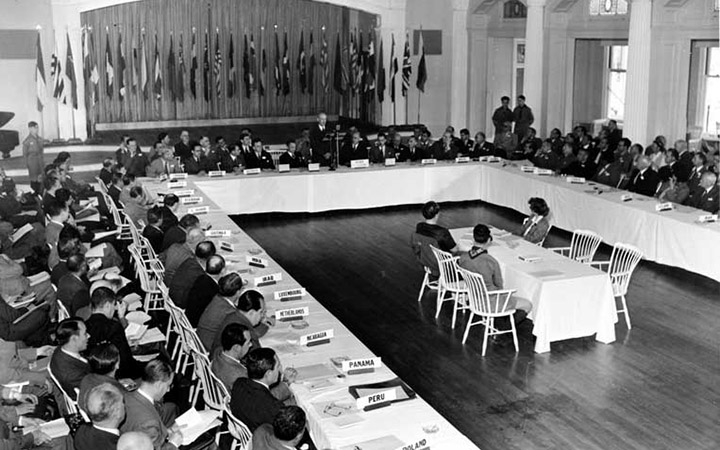
Creation of the Bretton Woods System, New Hampshire, 1944 (Photo: Associated Press; Photographer: Abe Fox)
Under the system, other countries maintained fixed exchange rates relative to the dollar. Only the US promised gold convertibility. That gave the dollar reserve status and allowed the US to run deficits while exporting inflation. Dollars flowed abroad, but gold stayed put. Over time, the gap between printed dollars and gold reserves widened. The US could finance wars and domestic programs without direct restraint. What began as stability turned into imbalance.
The Triffin Dilemma and the Collapse of the Gold Peg
Economist Robert Triffin predicted the contradiction early. For global trade to function, the world needed dollars. But for those dollars to keep value, they had to be backed by US gold. The more dollars in circulation, the weaker that promise became. In the 1960s, foreign nations began exchanging their dollar reserves for physical gold. France famously repatriated its holdings. US gold reserves shrank, confidence cracked, and the system became unsustainable.
In August 1971, President Nixon suspended gold convertibility. Announced as temporary, it became permanent. Bretton Woods was officially over. The dollar remained the global currency, but now without gold backing. Fiat currency, money based on policy rather than metal, became the standard. This marked a turning point in the history of money and a shift in how trust and value are defined in modern finance.

President Nixon announces the end of gold convertibility, 1971 (Richard Nixon Library)
Why the Gold Standard Ended and What Remains Today
Bretton Woods collapsed, but its architecture left a mark. The dollar stayed dominant. And the institutions it created, the International Monetary Fund and the World Bank, continue to influence global economies. Today, the IMF imposes loan terms on struggling countries, often requiring fiscal austerity or privatization. The World Bank directs capital to infrastructure projects, though critics argue that both institutions reinforce dependency. Their reach proves that Bretton Woods was not just about gold, but also about power.
Some argue that Bretton Woods benefited the United States disproportionately. Because the dollar became the world’s reserve currency, the U.S. could spend more than it earned and pay for imports with its own currency. Over time, this produced today’s global trade pattern: countries like China and Germany run persistent surpluses by exporting, while the United States runs persistent deficits by consuming.
The legacy is a financial system where most reserves, commodities, and international debts are dollar based. Crises often begin with the dollar and ripple outward. Today’s debt driven economy is still anchored in choices made in 1944. The effects are visible in national GDP and debt ratios worldwide.
The same forces that caused collapse in the past remain active – only in new form.
Why Bretton Woods Still Matters in a Fiat World
Today’s monetary system operates without a hard anchor. It relies on trust, institutional control, and global consensus. That system is under strain. Inflation, rising debt, and calls for alternative assets like Bitcoin are not just trends. They are reactions to deeper issues that began with Bretton Woods. The end of the gold standard did not remove the imbalance. It only removed the safety valve.
If money is backed by nothing, the system is built on trust. And trust is easier to lose than gold.