

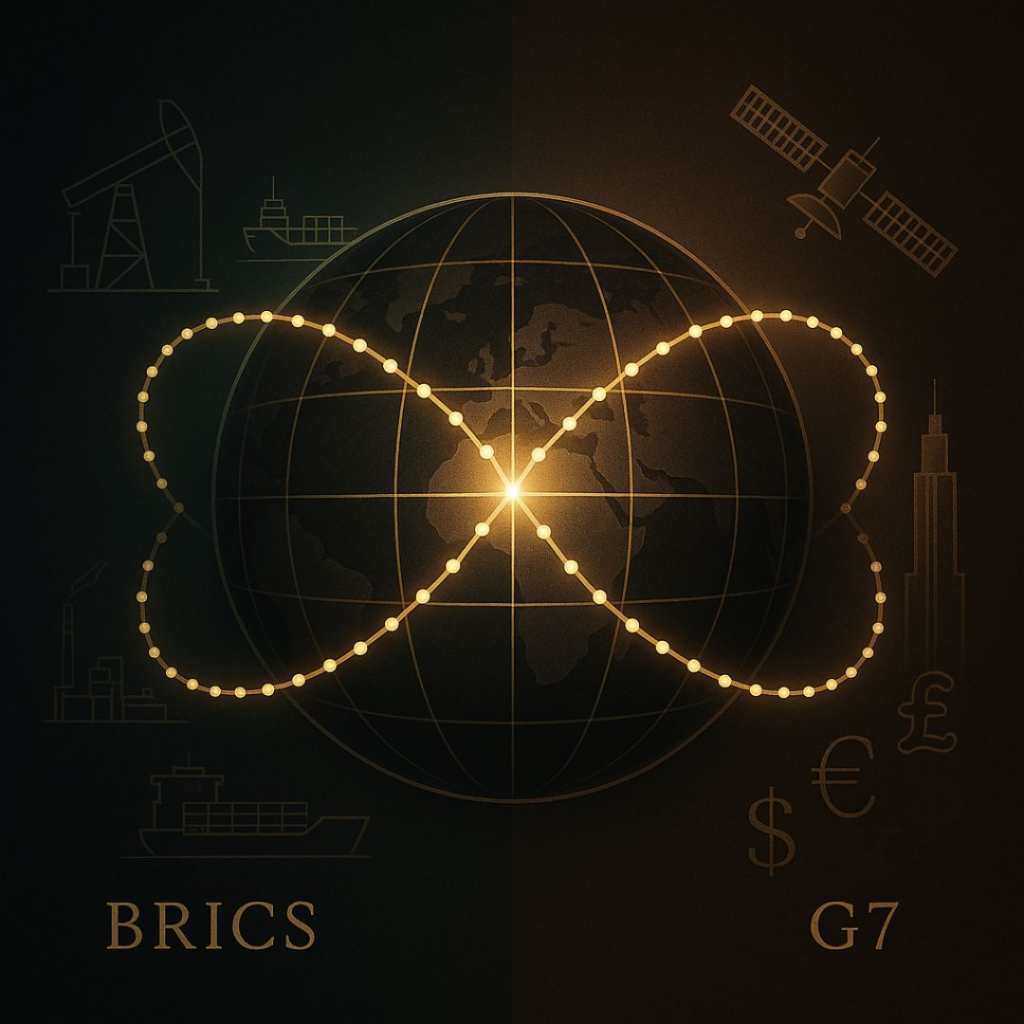
The global balance of power is usually framed as a contest between the Group of Seven (G7) and the BRICS bloc. Both matter, but they represent different eras and different models. The G7 groups together advanced industrial democracies that shaped the post-war financial order. BRICS brings together large emerging economies that want a louder voice in rewriting parts of it. Their rivalry shows where power is shifting in the 21st century.
- Origins: G7 began in the 1970s; BRICS formally launched in 2009
- Scale: BRICS holds more people and resources; G7 holds more wealth per capita
- Direction: G7 leads in finance and technology; BRICS expands through trade, energy, and infrastructure
Origins and Expansion
The G7 began in 1975 when leaders of the United States, Japan, Germany, France, the United Kingdom, and Italy met to respond to oil shocks and recession. Canada joined a year later. The European Union is not a formal member but participates in all meetings. The group functions as a coordination forum for advanced economies on finance, trade, sanctions, and security. It does not pass laws, but its consensus often influences global institutions.
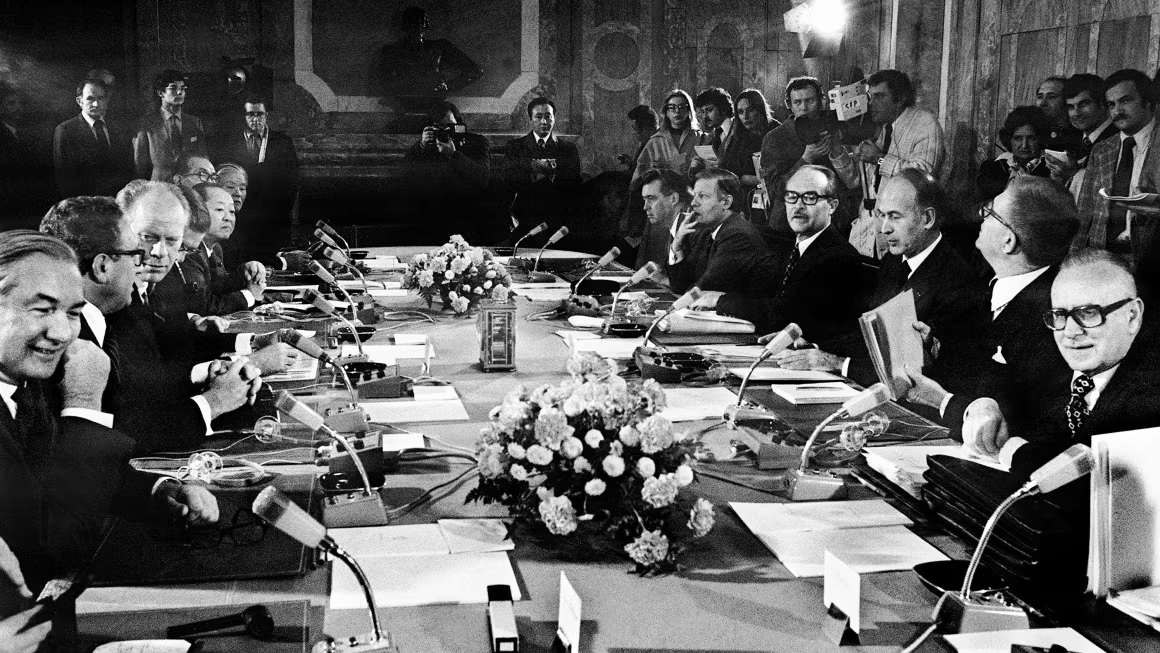
First monetary policy G7 meeting, 1975
BRICS came later. Brazil, Russia, India, and China formed the group in 2009, with South Africa joining in 2010. A significant expansion followed in 2024, when Egypt, Ethiopia, Iran, and the United Arab Emirates became members. Indonesia joined in 2025. The enlarged BRICS+ now positions itself as a platform for the Global South and a counterweight to Western-led financial institutions.
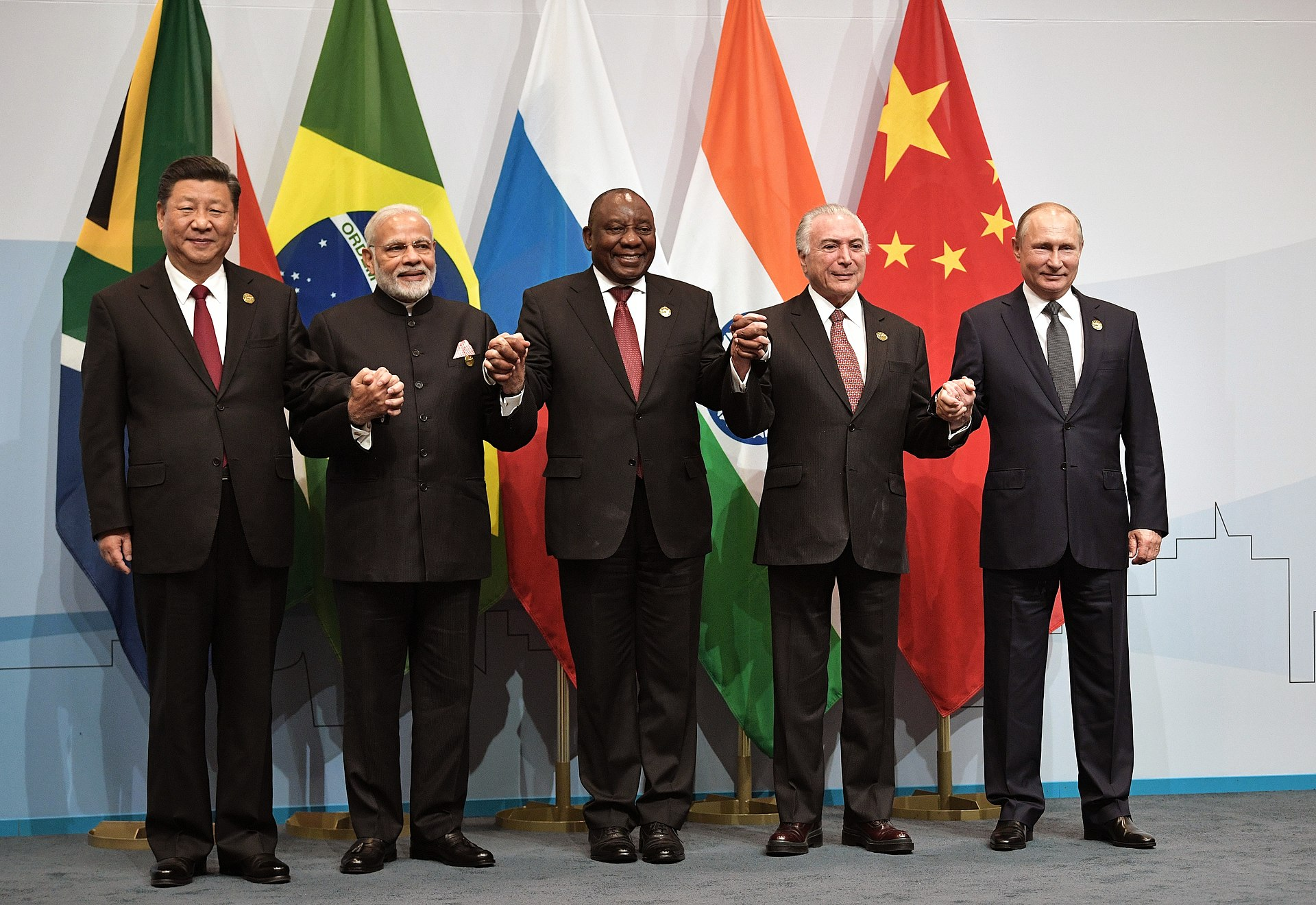
Group photo of BRICS leaders at the 2018 summit
In population terms, the contrast is strong. BRICS+ represents roughly 4.3 billion people, more than half of humanity. The G7 accounts for around 780 million. Influence, however, is not measured by headcount alone.
In nominal GDP, measured at current exchange rates, the G7 still produces close to 45% of global output. Adjusted for purchasing power parity (local prices), BRICS overtook the G7 in the mid-2010s, largely due to China’s industrial scale and India’s growth. The difference highlights a simple truth: one bloc dominates global finance, the other dominates global volume.
Debt, Trade, and Currency Power
Public debt levels are generally higher across G7 economies, often exceeding 100% of GDP. That reflects decades of mature welfare states, crisis spending, and aging populations. BRICS countries vary widely, but on average remain lower. Lower debt does not guarantee stability, though it does buy room to maneuver.
We explored the GDP and debt behind global trade balances in more detail here.
In trade, the G7 continues to dominate high-value services, advanced manufacturing, and foreign direct investment. BRICS economies export vast quantities of manufactured goods, commodities, and energy. China remains the world’s largest goods exporter. The structure of trade reveals different strengths: intellectual property and capital markets on one side, scale and resources on the other.
Currency power still sits firmly with the G7. The US dollar anchors global reserves and trade settlement, with the euro in second place. Together they clear the majority of cross-border payments. BRICS members are exploring alternatives, which we analyzed in our breakdown on The Shift to a Multipolar Payments System, but replacing entrenched financial plumbing tends to take longer than announcing it.
Security and Strategic Resources
Militarily, the G7 retains an edge because of the United States, which spends more on defense than any other nation and maintains extensive alliance networks across Europe and Asia. BRICS includes three of the world’s top five military spenders (China, India, and Russia) but operates without a unified defense structure. Coordination exists, though it is selective.
Energy tilts more toward BRICS+. With major oil and gas producers such as Russia, Iran, the UAE, and Brazil inside the bloc, it represents a significant share of global reserves and exports. Global oil demand remains above 100 million barrels per day in 2025, keeping energy geopolitics central despite the long-term transition to renewables. Control over supply routes still matters.
Infrastructure amplifies that leverage. China’s Belt and Road Initiative now spans around 150 partner countries and has shifted toward smaller, commercially focused projects after years of rapid expansion. For many BRICS members, it offers financing and logistics links that Western lenders either approach cautiously or condition heavily.
Political Realities
Domestic politics determine how far each bloc can plan ahead. Several BRICS leaders govern with strong parliamentary or electoral mandates. G7 governments, by contrast, face tighter margins, aging electorates, and frequent election cycles. Democratic accountability brings more resilience, but it can also compress long-term strategy into four-year windows.
Data shows leaders in many BRICS states hold higher approval at home, with India’s Narendra Modi near 70% and others with firm majorities. In the G7, leaders are under stronger pressure. France’s Emmanuel Macron polls near 15% and the United Kingdom’s Keir Starmer near 13%. Costs of living, immigration debates, and the focus on foreign conflicts weigh on trust.
BRICS vs G7: A Long Contest
The G7 remains stronger in finance, advanced technology, and formal alliance systems. BRICS+ holds demographic weight, resource depth, and faster aggregate growth. Neither bloc is positioned to eclipse the other outright. Their economies remain intertwined, their supply chains overlapping, and their institutions partially shared.
“Power rarely shifts in a single summit. It accumulates, quietly and incrementally.” — Stijn McAdam
Explore more related deep dives on power, finance, and geopolitics:
- Why Rare Earths Became the Currency of Power
- The Arctic Power Map
- Realism vs Liberalism in International Relations
- Taiwan as a Geopolitical Chokepoint
Great powers endure when they adjust to new realities. For people, the rule is no different.