


The deepest divide in international relations runs between two schools of thought: realism and liberalism.
Realism sees a world without a central authority, where power and security largely determine outcomes. Liberalism argues that democracy, trade, and international institutions can reduce conflict and make cooperation durable. Both theories seek to explain patterns of war and peace, but they start from very different assumptions.
- Realism: power and security drive states in an anarchic system; war remains a tool of statecraft
- Liberalism: cooperation through democracy, trade, and institutions can make peace possible
- Main split: conflict as inevitable vs peace as achievable
What Realism Says
Realism begins with the idea of anarchy: there is no global government above states. Because no higher authority guarantees their safety, states must rely on themselves. This creates security dilemmas and recurring power struggles. Classical realism traces this dynamic to human ambition and the desire for prestige, as seen in figures like Napoleon. Structural realism shifts the focus from human nature to the structure of the system itself, arguing that even cautious leaders are pushed to compete for power.
China’s Century of Humiliation (1839–1949), when foreign powers exploited its weakness, illustrates why states often seek greater power to secure their survival. Defensive realists reason that states aim for enough power to remain safe. Offensive realists contend that great powers will pursue maximum advantage when the costs appear low and the odds of success are high.
In The Tragedy of Great Power Politics (2001), political scientist John Mearsheimer argues that because no state can ever be certain of another’s intentions, great powers are pushed to compete for regional dominance whenever the opportunity arises. In his formulation, rivalry is not the result of misunderstanding or poor leadership, but a structural feature of the international system itself.

At the turn of the 20th century, foreign powers carved spheres of influence out of Chinese territory after the Boxer Protocol (1901).
What Liberalism Says
Liberalism accepts the absence of a world government but insists that stable cooperation is possible. Democratic peace theory holds that mature democracies rarely fight one another because public oversight, shared norms, and political transparency raise the domestic cost of war. Economic interdependence suggests that deep trade and investment ties make conflict less attractive: harming a major trading partner can damage your own prosperity. Institutionalism adds that rules and forums such as the UN and the WTO reduce uncertainty, provide information, and create mechanisms for resolving disputes.
Where They Differ
The core divide is conflict versus cooperation. Realists see recurring power struggles as unavoidable in an anarchic system, where survival ultimately overrides other goals. Liberals argue that democracy, trade, and institutions can build trust over time and make sustained peace possible.
In The End of History and the Last Man (1992), political scientist Francis Fukuyama suggested that liberal democracy and market capitalism might represent the final stage of political evolution. He did not claim that wars would disappear, but rather that no rival system offered a coherent alternative with global appeal. Subsequent decades, marked by renewed great-power rivalry and internal struggles within democracies themselves, have made that conclusion far more contested.
A second difference concerns the durability of trust. Realists maintain that even long periods of cooperation cannot eliminate the underlying uncertainty between states, since power balances can shift and intentions can change. Liberals counter that repeated interaction, transparency, and shared institutions can gradually build confidence, especially among democracies, making conflict less likely over time.
A growing question is whether these classic frameworks are sufficient for the future. Emerging technologies are creating new forms of power and governance in ways that do not fit neatly into either camp, posing challenges for both realists and liberals.
Examples That Show the Divide
Before 1914, Europe was deeply interconnected through trade and finance. Many believed that shared prosperity would safeguard peace. It did not. Rival blocs, the Triple Entente and the Triple Alliance, tied states into binding commitments. Even though trade and economic ties existed across blocs, Germany and other leaders felt strategically threatened, fearing encirclement and the risk of a two-front war. In that moment, survival outweighed prosperity, and escalation followed rapidly, sparking the First World War.
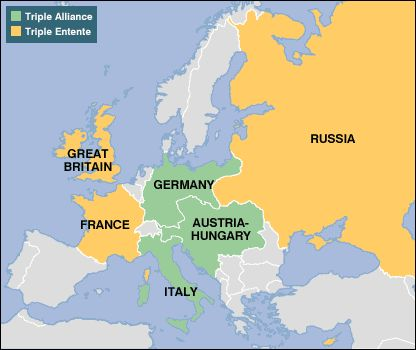
Europe before World War I was divided between two rival blocs: the Triple Alliance and the Triple Entente.
The expansion of a military alliance toward a great power is a clear test of survival logic. Supporters argued that incorporating Ukraine into NATO would spread stability and democratic norms across Europe. Critics warned it would cross Moscow’s red line: from a realist perspective, NATO deterrence on Russia’s border threatened its security. In 2022, these concerns erupted into war, as Russia acted to defend what it perceived as vital security space.
Interestingly, this logic has a long precedent in American practice. The Monroe Doctrine (1823) warned European powers (notably Spain, France, and Britain which still controlled large parts of the Americas) not to intervene militarily in the Western Hemisphere. What’s lesser known is that it reflected mutual restraint: the US would avoid European entanglements if Europe stayed out of the Americas. The 1962 Cuban Missile Crisis later showed how seriously these red lines were enforced.
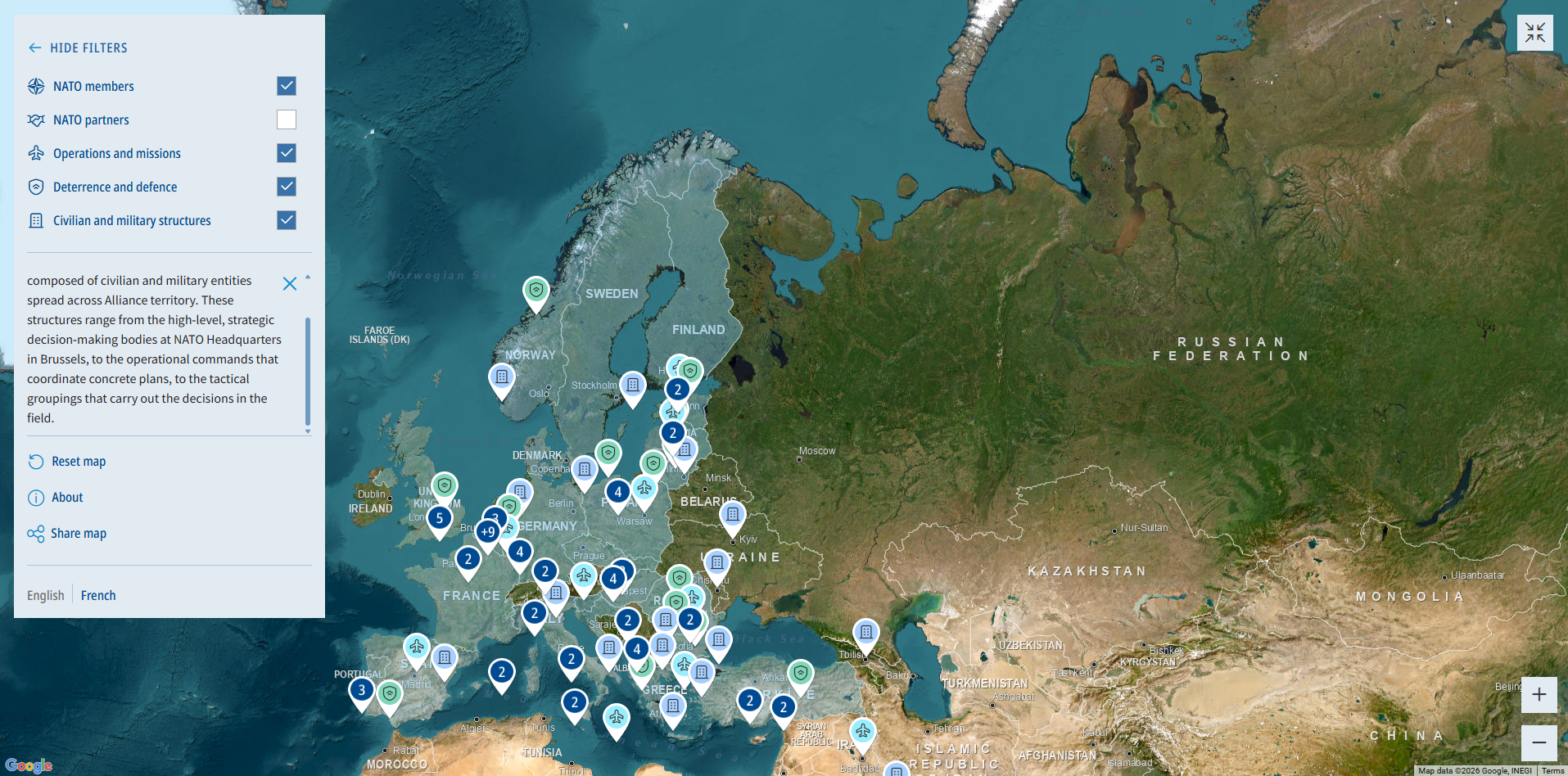
NATO on the Map. Source: NATO.
China’s rise places both lenses side by side. One perspective expects deep trade ties and shared rules to integrate China into a largely peaceful order, with projects like the Belt and Road Initiative expanding infrastructure and commerce. The other anticipates friction as the balance of power shifts and established powers seek to protect their position. Technology restrictions, supply chain restructuring, and alliance-building in Asia suggest that competition over capabilities now stands alongside commerce.
History shows that liberal powers often act differently in practice than in principle. Interventions are framed as defending democracy or human rights, yet they have also included coups, sanctions, covert wars, and regime change – sometimes openly acknowledged. These actions rarely bring stability and frequently generate new threats. Realists argue that beneath the rhetoric of liberal ideals lies a familiar logic of dominance and strategic control.
Great powers rise on strength and order. The same rule applies to you.