


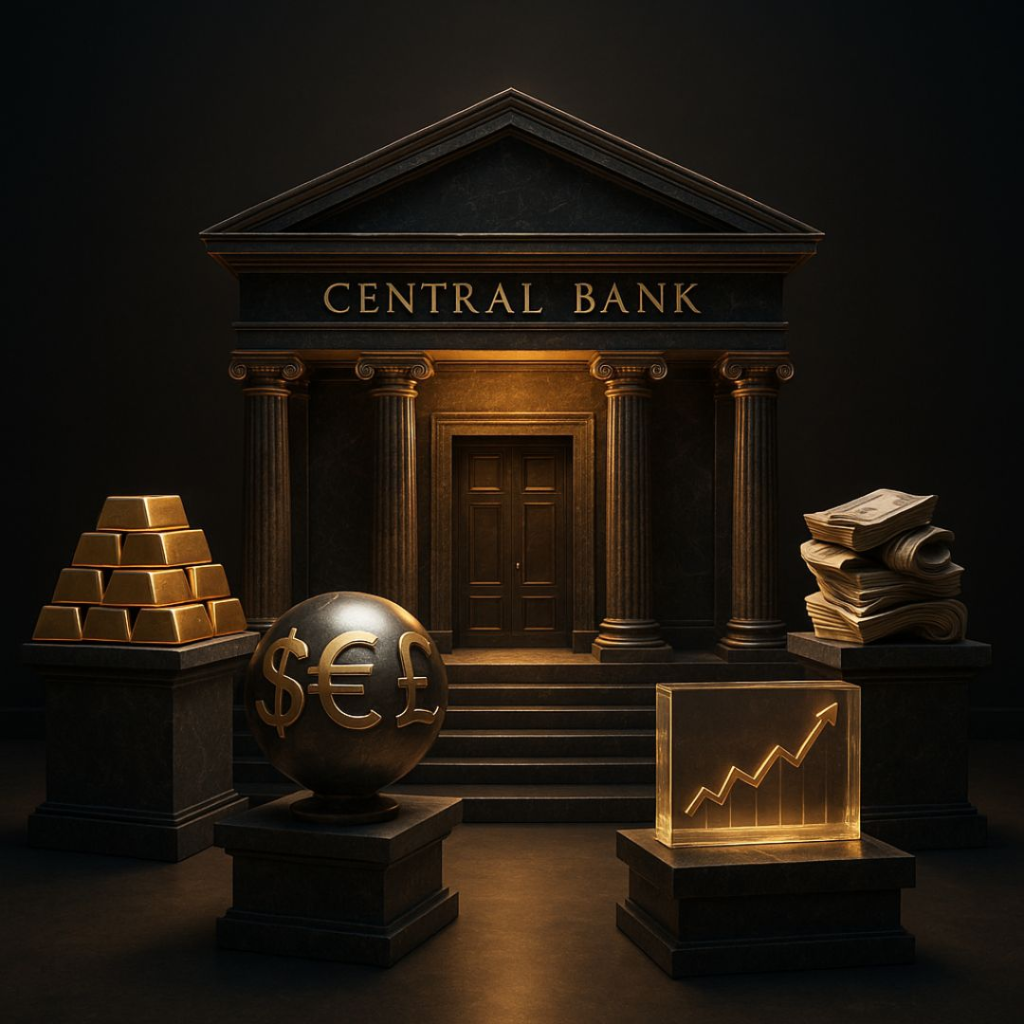
Central banks are the referees of money. They raise or cut interest rates and adjust cash in the system through bond programs, guiding how investors, businesses, and governments plan ahead. Their choices decide how fast prices rise, how heavy debts feel, and how currencies trade against one another.
- Purpose: Keep inflation contained and the system stable
- Tools: Policy rates, balance sheet moves (QE and QT), lender of last resort
- Independence: Built to resist politics, often tested in practice
- Importance: The dollar is the main reserve and funding currency
What Central Banks Do
Central banks set the price of money. That decision affects mortgages, business loans, savings yields, and how investors value future cash flows. To read markets with accuracy, start with policy; everything else reacts.
How Policy Works
The policy rate is the main lever. Raising it makes credit more costly and slows demand. Cutting it lowers near-term funding costs. Balance sheet policy is the second lever. QE buys bonds and adds liquidity. QT lets bonds run off and removes liquidity. In stress a central bank lends against good collateral so solvent banks do not fail for lack of cash.
Central Bank Independence and Mandates
The US Federal Reserve, founded in 1913, has a dual mandate: price stability and maximum employment. Policy is set by the FOMC, combining the Board of Governors and regional Fed presidents. Long terms limit political control, but pressure still appears. If policy looks partisan, people assume it will bend to short-term politics through easy money or higher deficits, which weakens confidence in price stability and pushes inflation expectations higher.
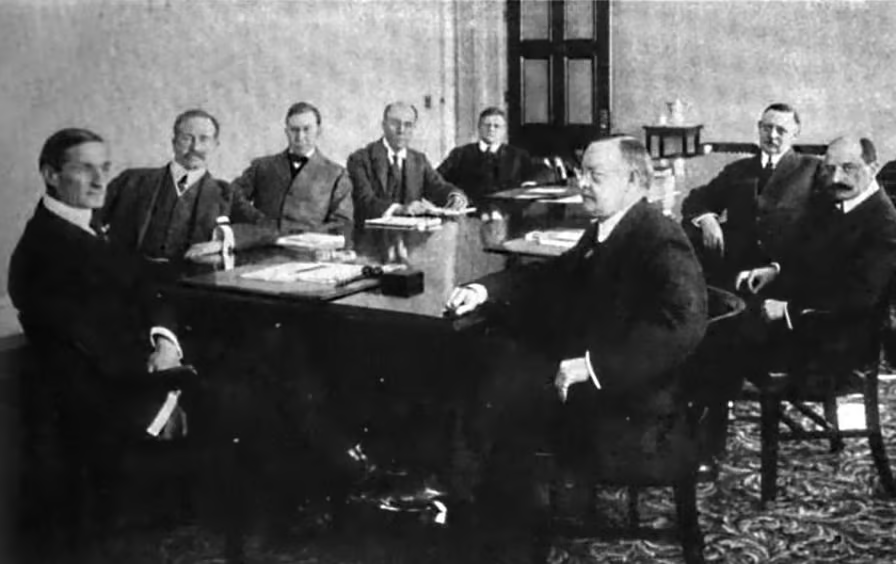
The Federal Reserve Board, 1917
Mandates differ elsewhere. The European Central Bank targets 2% inflation. The Bank of England also targets 2% while supporting growth.
Money Buys Less, Debt Builds Up
Since 1913 the dollar has lost more than 96% of its buying power. Under Bretton Woods the dollar was convertible to gold at 35 dollars per ounce, which limited money creation. In 1971 the gold link ended, removing that hard constraint. US federal debt was under 400 billion dollars then; today it is above 38 trillion.
Debt is driven by Congress, which sets spending and taxes. The Treasury funds deficits by issuing bills, notes, and bonds. The Fed does not run the budget; it can only buy Treasuries later in the secondary market, affecting yields and liquidity, but it is not obligated to do so.
- At auction: Primary dealers and other investors bid for new Treasury supply.
- If demand is weak: Yields rise until the market clears. Higher yields lift interest costs.
- If stress builds: The Fed can buy Treasuries in the secondary market (QE) to steady funding and lower yields. It can also let holdings run off (QT) to tighten conditions.
Over long periods the mix of rates, inflation, and balance sheet policy decides how fast money loses buying power and how governments carry heavy debt. When interest rates are lower than inflation, the value of debt shrinks over time, but people’s savings lose purchasing power. When interest rates are much higher, the government and households pay more to service their loans, which leaves less money for spending and slows the economy.
Pro Insight: What matters most is the real interest rate: the policy rate minus inflation. In the early 1980s, Fed Chair Paul Volcker pushed rates near 20% while inflation was about 13%; a real rate around 7%. Today, with policy rates above 4% and official inflation near 3%, real rates are again positive. The catch: inflation is measured differently now, so today’s stance may be a lot less restrictive than the numbers suggest.
Why the Fed Moves the World
The dollar remains the main reserve and funding currency. More than half of global official reserves sit in dollars, and much trade and commodity finance is denominated in dollars. When the Fed shifts policy, global borrowing costs, exchange rates, and commodity prices adjust.
What to Watch
Markets trade on expectations. To stay ahead of central bank moves, keep an eye not only on Federal Reserve meetings but also on the economic reports that shape policy decisions. A practical way to follow them in one place is through the Forex Factory calendar, which lists upcoming inflation prints, jobs data, GDP releases, and central bank meetings worldwide.
- FOMC meetings: The statement, dot plot, balance sheet signals (QE or QT), and the Chair’s press conference.
- Inflation data: CPI and the Fed’s preferred core PCE gauge. Trends matter more than one print.
- Jobs reports: Monthly payrolls and unemployment show labor demand and wage pressure.
- GDP growth: How fast the economy expands or contracts.
- Other indicators: Consumer confidence, ISM surveys, and credit conditions round out the picture.
How Assets Tend to React
Assets don’t move in straight lines, but broad patterns show up over time:
| Condition | Typical Market Reaction |
|---|---|
| Falling rates + low inflation | Bonds rise (yields fall), stocks rise, gold steady, dollar weaker |
| Rising rates + high inflation | Bonds fall (yields rise), stocks fall, gold rises, dollar stronger |
| Rising rates + stable inflation | Bonds mixed, stocks often hold up, gold flat, dollar stronger |
| Recession fears | Bonds rise (safe haven), stocks fall, gold rises, dollar mixed |
| Strong growth + stable inflation | Stocks rise, bonds steady or fall, gold softer, dollar stronger |
Read a practical map of the future of money.