



Neither Picasso nor Van Gogh made the golden sphere above. It shows a qubit, the core particle of quantum computing. Few technologies combine fascination and fear quite like this one. It used to be the kind of idea people joked about, but Google now says practical use could arrive within five years according to its latest projection. Even BlackRock, the world’s largest asset manager, mentioned “quantum risk” in its 2025 Bitcoin ETF filings. Behind the headlines lies a simple question: what happens when machines begin to calculate in probabilities instead of just zeros and ones?
Bits, qubits and deep-freeze machines
Conventional computers think in binary: zero or one, on or off. A quantum computer works differently. Its smallest unit, the qubit, can exist as both zero and one at the same time. This allows it to test millions of outcomes simultaneously instead of one after another. But qubits are fragile. A small vibration, burst of heat, or magnetic fluctuation can collapse their balance. To stop that from happening, scientists combine many qubits to form a single, more reliable “logical” qubit; a kind of stabilized version that can hold information long enough to compute.
Even then, the system must stay extremely cold. Quantum processors are cooled to near absolute zero, colder than outer space. Inside these chambers hang metallic towers of wires and sensors, machines that look more like golden chandeliers than computers. They run for only fractions of a second before the qubits lose balance and computation ends.
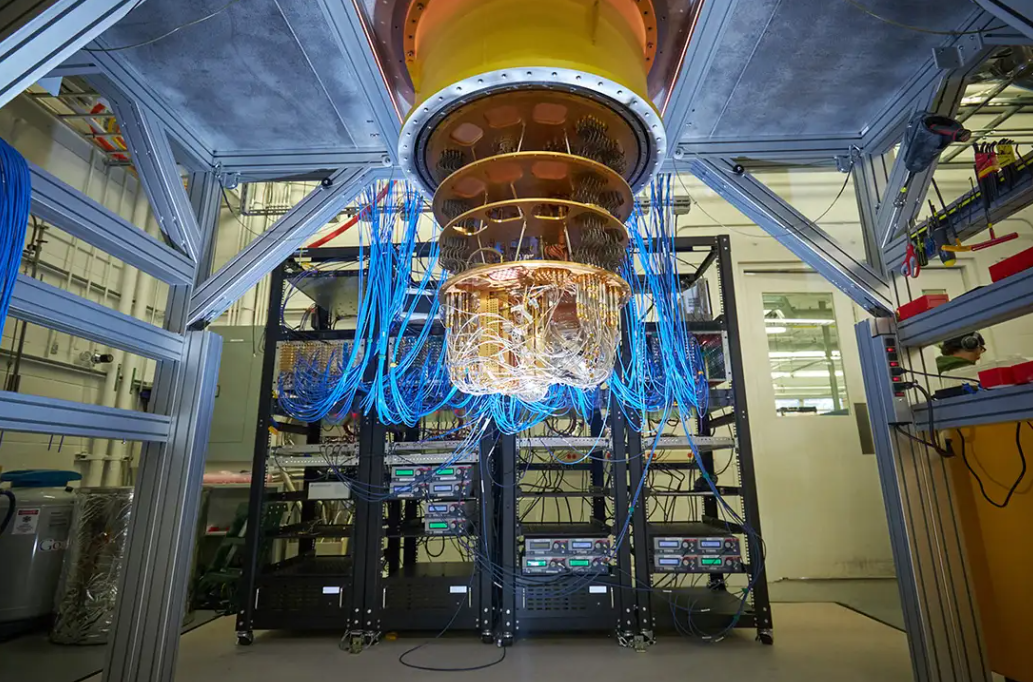
Photo: Rocco Ceselin / Google
Promise: solving the unsolvable
Why build a machine that must live in deep freeze? Because it can solve problems no other computer can. Quantum processors do not just calculate faster, they follow a different logic. Their strength lies in modeling systems that overwhelm classical mathematics: decoding molecular reactions, testing the limits of cryptography, or simulating the formation of stars and the structure of space-time. Problems that would take today’s fastest supercomputers longer than the universe has existed could, in theory, be cracked in seconds once quantum hardware matures.
“If quantum mechanics hasn’t profoundly shocked you, you haven’t understood it yet.” — Niels Bohr
Threat: cracking our digital locks
The same power that makes quantum computing exciting also makes it dangerous. Every bank transfer, classified archive, and national ID system depends on encryption built from math problems that classical computers can’t solve. A mature quantum machine could break those defenses in seconds, exposing financial systems, personal identities, and even state secrets.
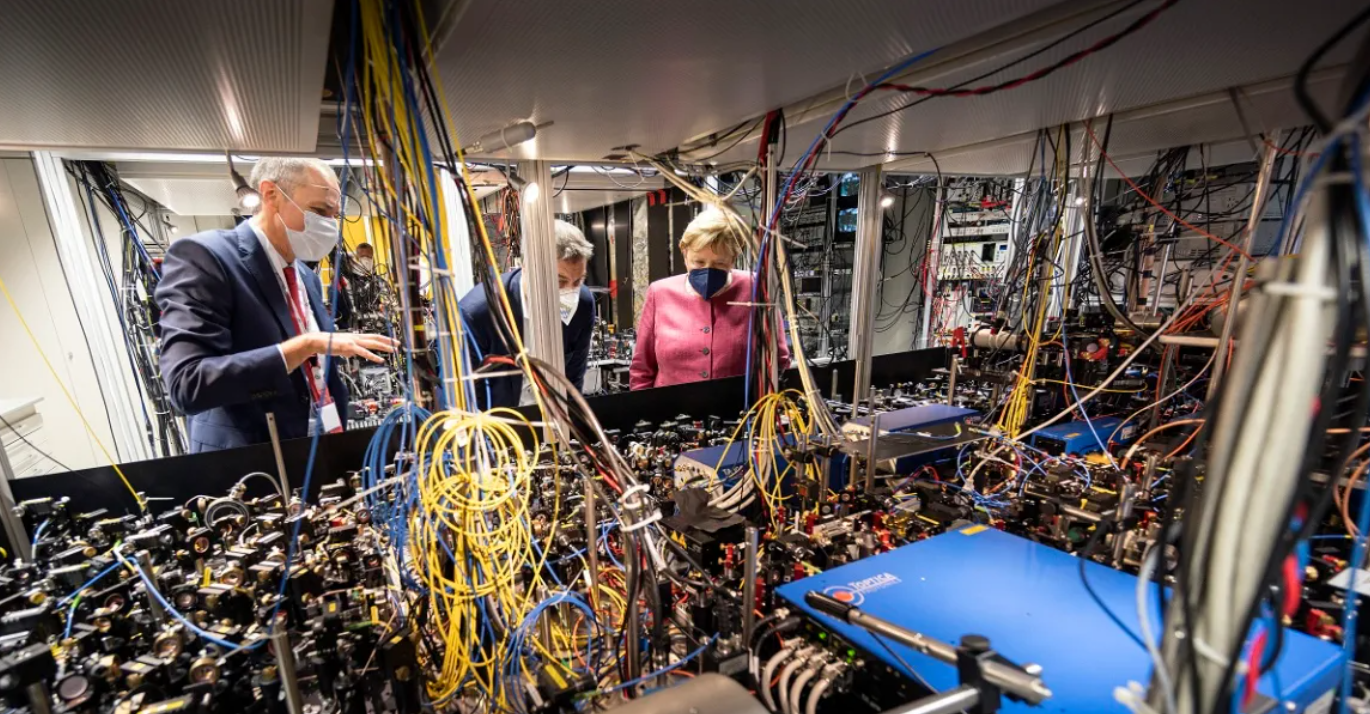
Photo: Guido Bergmann / Bundesregierung via Getty Images
Bitcoin and the race for quantum resistance
Bitcoin’s security rests on two cryptographic pillars: SHA-256 hashing and digital signatures. Quantum computers could eventually undermine both. Roughly 25% of all existing bitcoin still sits in older wallets that reveal too much information. If quantum development accelerates, those exposed wallets could be among the first targets. Developers have proposed migrating all funds to new, quantum-resistant addresses before that happens. But Bitcoin can’t change overnight. Any upgrade would require global consensus from miners, wallet providers, and exchanges that together uphold the network’s rules.
Did you know? When Bitcoin’s community couldn’t agree on how to scale the network in 2017, the debate, known as the Blocksize Wars, led to a “hard fork”: a permanent split in the blockchain. One side kept Bitcoin (BTC) as we know it, while the other created Bitcoin Cash (BCH), which increased block size to allow more transactions.
Preparing for a post-quantum world
Across governments and industries, the shift to quantum-resistant security has already begun. The U.S. National Institute of Standards and Technology released its first post-quantum encryption standards in 2024. Europe and Asia are testing these algorithms in pilot programs for digital IDs and payment systems. In crypto, developers are experimenting with hybrid signatures that combine traditional and quantum-safe code.
Outlook
Quantum computing is still in its prototype phase. Most machines operate with fewer than 1,000 physical qubits, while breaking modern encryption would require at least one million stable logical qubits. That technical gap points to a likely timeline of 8 to 12 years, according to IBM and leading research groups.
Progress, however, is uneven rather than slow. Quantum simulators are already helping scientists design new materials, drugs, and energy systems at a scale no classical computer can match. Finance and logistics firms are beginning to test early quantum models for optimization tasks, problems that involve billions of possible routes or trades.
The threat to encryption is real but not immediate. The organizations preparing now will be the ones ready when this technology leaves the lab.
Continue exploring how technology is reordering our world:
- The Dangerous Race to Superintelligence
- AI, AGI and CGI Made Clear
- Chips Decide Global Power in US–China Tech Race
- Technocracy and the Future of Governance
The machines are learning faster every year. Fit & Free is about making sure we do too.