


In the largest liquidation event in crypto history, more than 1.6 million traders lost their positions and over $19 billion in leveraged trades were wiped out. For context, the market crash during COVID-19 in March 2020 caused about $1.2 billion in liquidations, while the FTX collapse in 2022 led to around $1.6 billion.
Understanding What Happened
The trigger came from politics. After President Donald Trump announced new hostility toward China, global markets began selling off. Hours later, with U.S. markets closed, he confirmed a 100% tariff on Chinese imports. Because crypto trades nonstop, selling pressure during low-liquidity hours quickly turned into a cascade of automatic liquidations across exchanges.
About a quarter of all liquidations came from Bitcoin, meaning overleveraged altcoin traders took the biggest hits. Yet, the cause ran deeper than a headline. The tariff news may have been the spark, but the real damage was driven by conditions within the industry.
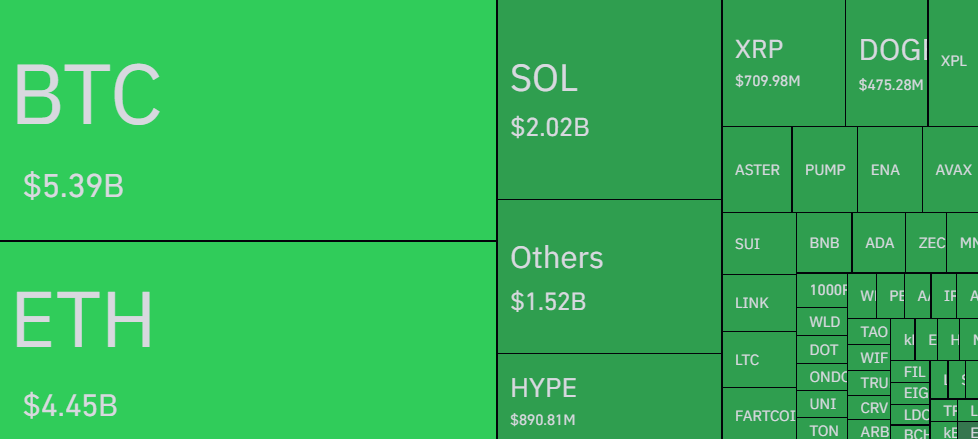
Data and visualization: Coinglass
Leverage trading: A trader expects a coin to rise and opens a long position using $1,000 of their own money while borrowing $9,000 from the exchange to control $10,000. This is 10× leverage, meaning each 1% move in price produces about a 10% gain or loss on the trader’s capital. If the price falls roughly 10%, the trader’s equity is wiped out and the exchange automatically closes the position to recover its loan. These forced closures are called liquidations. When many leveraged positions are liquidated at once, the selling pushes prices down further, triggering even more liquidations in a self-reinforcing spiral. The same mechanism works in reverse for short positions.
This is only the basics. We explore these dynamics in depth in my books Crypto from Scratch and Trade Smart.
CEX vs DEX
During the event, many exchange systems broke under pressure. Stop losses failed to trigger, orders went unfilled, and users were unable to add margin as platforms became unstable within minutes. The liquidation cascade unfolded so quickly that most traders had no time to react, leaving billions in positions closed automatically.
Most trading still happens on centralized exchanges (CEX) such as Binance, Bybit, and OKX. These platforms act as intermediaries and hold user funds in their own accounts. A newer alternative is the decentralized exchange (DEX) like Hyperliquid, where trades are executed by smart contracts and users retain control of their assets. The sharpest declines in altcoins occurred almost entirely on centralized exchanges, suggesting that the wave of liquidations was driven primarily by liquidity issues stemming from the exchange itself or its market-maker.
Did you know? A large trader opened over a billion dollars in short positions on Hyperliquid just before the tariff announcement, later closing them for an estimated $200 million profit.
The Industry’s Contradiction
Crypto was created to escape centralized control. In 2009, Satoshi Nakamoto introduced Bitcoin as a direct response to failing banks and government bailouts. The message encoded in Bitcoin’s first block, “Chancellor on the brink of second bailout for banks,” was a clear protest against financial manipulation. It offered a peer-to-peer system built on transparency, free from middlemen and hidden power.

Photo: Getty
Sixteen years later, the picture is very different. Financial giants such as BlackRock and Fidelity now facilitate Bitcoin exposure for their clients, while governments experiment with digital versions of their national currencies. A movement once meant to avoid the banking system has become closely connected to them.
The Dark Side of the Boom
The industry’s rapid growth has exposed its less glamorous side. Over time, several patterns have become impossible to ignore:
- Influencers and celebrities promote “projects” they’re secretly paid to endorse, then dump them on followers.
- Exchanges act as gatekeepers, demanding high listing fees or a share of project tokens before approval.
- Public companies issue debt or new shares to buy crypto for their balance sheets.
- Rogue market makers manipulate prices behind the scenes.
- Thousands of new tokens launch daily with just a few clicks, many designed for pump-and-dumps.
- Hacking groups such as Lazarus continue draining billions through sophisticated exploits.
- World leaders like Trump and Milei have launched or endorsed their own memecoins.
Every cycle ends the same way: capital flows from retail traders to larger players. I have seen parts of this up close; that story is for another time.
Where Crypto Goes from Here
Millions lost much of their capital in this event. High leverage, fragile liquidity, and an industry increasingly dominated by large institutions created a system where small shocks can trigger outsized reactions.
None of this means the underlying technology is disappearing. Blockchains, smart contracts, and digital assets are not going anywhere. What is changing is how the technology is being used and by whom.
Stablecoins, tokenized assets, and digital identity systems are rapidly becoming building blocks of a new financial architecture. Rather than replacing the old system, parts of crypto are now helping construct it. We explore this emerging structure in more detail in The Digital Control Grid.
Continue exploring power, money, and technology:
- The US–China tech race
- New Global Power Balance
- How Central Banks Move Markets
- The Network Behind Silicon Valley
- Information Warfare
Understand the system before using it.