



Open TikTok, Instagram Reels, or YouTube Shorts for ten minutes, and pay attention to what keeps coming back.
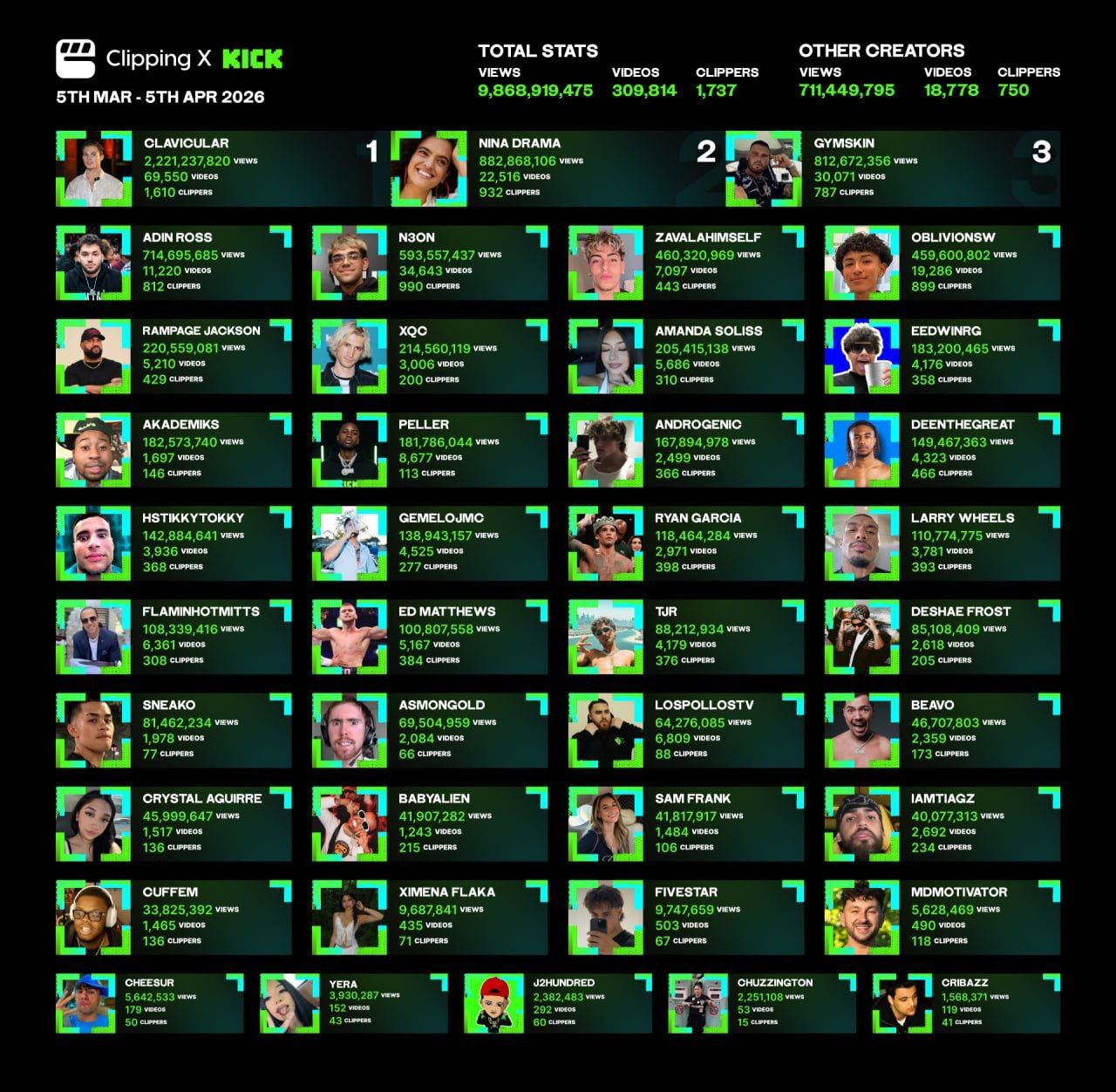
You will likely run into creators like Clavicular (a self-branded “looksmaxxer”) or streamers such as Adin Ross and N3on. Chances are you do not follow them, which is understandable, yet they keep showing up anyway. Coincidence? Not really. What you are seeing is paid distribution at industrial scale, designed to look organic.
Having worked on marketing campaigns that generated billions of views, I have seen firsthand how attention is carefully engineered. This latest wave of manufactured virality is what made me take a closer look again.
From Content to Distribution Machines
Most of what you see are 30–90 second snippets pulled from long livestreams and recycled across platforms. The people producing them are known as “clippers.”
The blueprint became obvious during Andrew Tate’s rise in 2022. Instead of relying on a single channel, Tate mobilized an army of clippers to extract provocative moments and flood short-form platforms. The model: create highly polarizing material, encourage mass redistribution, and reward participants through affiliate commissions tied to his platform, Hustlers University.
This was the shift. Clipping stopped being organic fan behavior and became an organized, incentivized growth strategy. Fast forward to now, and Clavicular generated over 2.2 billion views in a single month through roughly 69,000 clips, produced by more than 1,600 paid contributors working at the same time. I broke down his “inspirational” messaging separately in Soulmaxxing: A Response to the ‘Maxxing’ Culture.
How Clipping Campaigns Work
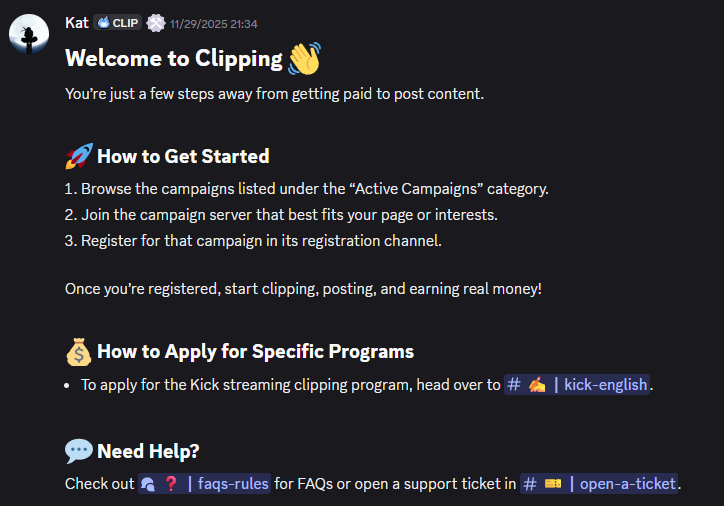
A majority of campaigns operate through large Discord servers with thousands of participants. Inside, users browse active campaigns linked to specific creators, podcasts, or brands.
Each campaign follows a structured model:
– A fixed CPM (payment per 1,000 views), typically between $0.10 and $0.50, sometimes higher
– Specific platforms to post on (TikTok, Reels, YouTube Shorts, sometimes X)
– Strict formatting and content requirements
According to a document shared with Business Insider, streamer N3on paid out over $1.4 million to 303 clippers in just five weeks.
Payment usually happens once your total output crosses a minimum threshold, often around 100,000 combined views, which strongly incentivizes volume. As a result, participants flood multiple platforms with dozens of clips, increasing their chances of getting paid.
Some campaigns add bonuses and bounties tied to specific clips or milestones, pushing even more output around selected moments. Payments are typically handled in crypto (often USDT), making the system global and easy to scale.
The First Layer: Overpowering the Algorithm
Modern recommendation systems rely heavily on signals that indicate importance. One of the strongest signals is volume. When tens of thousands of posts about the same person appear in a short time frame, the system reads that as relevance.
Clipping campaigns exploit this directly. They do not need to trick the algorithm. They overwhelm it with exactly the signals it was designed to reward.
The Second Layer: Organic Amplification
Once a creator reaches saturation, the second layer kicks in.
At that point, clips are no longer pushed only by paid contributors. They are picked up by regular users who react by criticizing, mocking, debating, or trying to capitalize on the trend themselves. Many of these creators are then invited onto large podcasts and collaborate with influencers or celebrities, exposing them to a much wider audience.
The result is a self-reinforcing loop. Paid distribution creates visibility. Visibility triggers organic reaction. That reaction produces more content, which strengthens the original signal even further.
Artificial amplification tools such as viewbots and engagement farms also exist in this space and often work alongside it. That said, the scale achieved through coordinated clipping alone is already enough to produce these effects.
Kick’s Role: Paying for Distribution
One of the main drivers behind this ecosystem is the streaming platform Kick. Instead of relying on creators to grow organically, Kick directly funds distribution through clipping programs. In practice, it outsources its marketing to thousands of independent contributors operating at scale.
The requirements are strict. Clips must follow exact guidelines, including mandatory branding. For example, the Kick logo must always be clearly visible and placed exactly according to specification. If it is missing or incorrectly positioned, the clip is rejected and no payment is issued.
“At scale, every clip becomes two things at once: content and advertisement, with no clear line between them for the average viewer.” — Stijn McAdam
The Stake Playbook
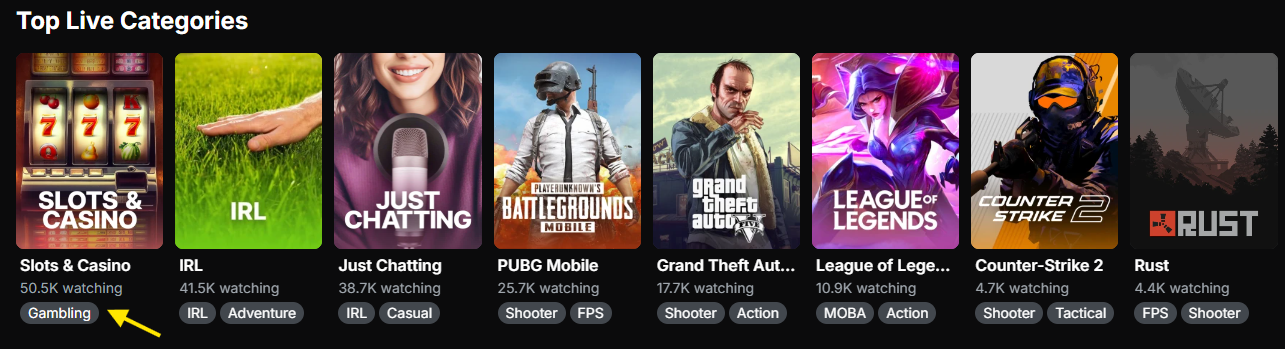
In October 2022, Twitch banned gambling streams involving unlicensed operators and explicitly named the platform Stake. Two months later, Kick was co-founded by the same people behind Stake, Ed Craven and Bijan Tehrani. Convenient timing.
Stake then expanded collaborations with streamers and YouTubers, including Drake, xQc, and Adin Ross, who streamed gambling content on Kick. So the question becomes: is Kick just competing with Twitch and YouTube, or functioning as a funnel?
Once inside the ecosystem, users are exposed to a disproportionate amount of gambling content. That exposure is the point. Even a conversion rate of 0.001% becomes meaningful when exposure reaches billions.
I flagged this accelerating trend toward digitized gambling last year, covered in The Online Gambling Pandemic.
Conclusion
If you feed the system enough clips, repetition, and noise, it will eventually start rewarding you. But zoom out a bit, and this points to something less technical. It starts to resemble something cultural. We seem to be moving through a more decadent phase of the cycle. This is just one expression of it, playing out through digital platforms.
On one side sits skill, patience, and real competence. On the other: shortcuts, low-effort content, and rapid attention capture. It is not hard to see which side scales better in these systems.
Younger audiences growing up inside these systems are adapting accordingly. If the game rewards clipping, reposting, and riding trends, that is what people will optimize for. The result is a wave of low-skill, low-effort content, produced at scale and feeding back into itself.
At the same time, there is clear demand for it. People are being conditioned to scroll, react, share, and repeat. The more brain-dead the content, the easier it spreads. Dopamine in, attention out. Substance takes longer, so it loses.
You can step outside of it, at least partially, by being more intentional about what you watch, share, and engage with. But most people won’t. And that, more than anything, is probably the clearest signal of where things are heading.
Continue exploring how modern life is impacting body and mind: