


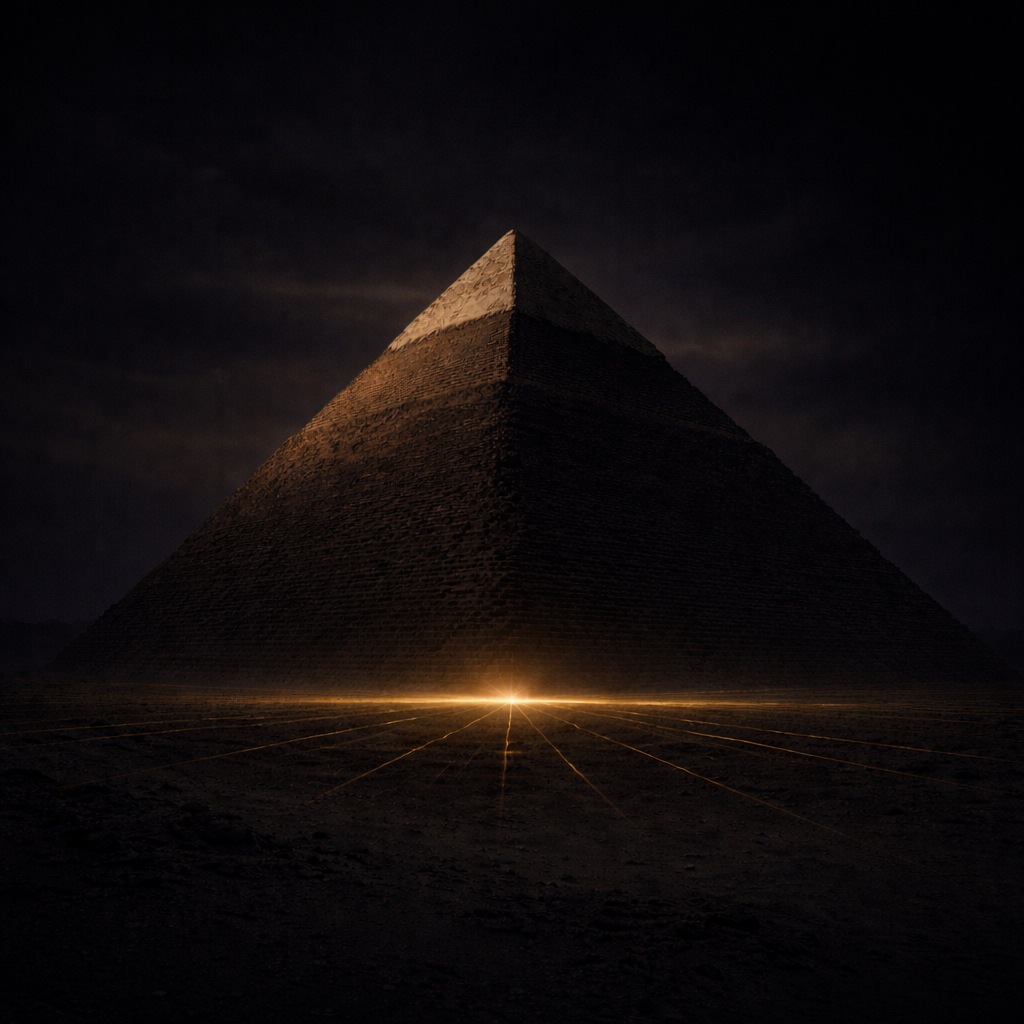
For thousands of years, humans have wondered about the Great Pyramid of Giza. We’ve been told it was a tomb, supposedly built around 2580 BCE, but the evidence doesn’t support this claim. The pyramid contains no elaborate wall art or inscriptions typical of royal burials, and no mummy has ever been found inside the King’s Chamber. Could its purpose have been entirely different?
Mysteries in the Stone
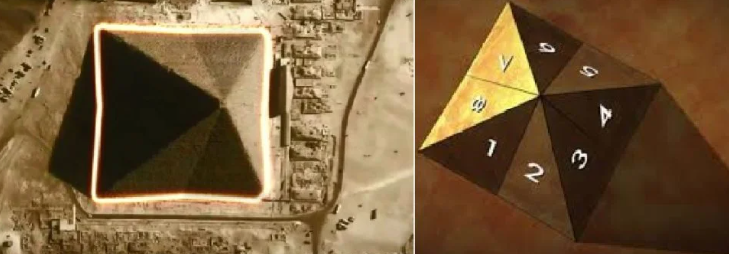
Consider this: over 2.5 million stone blocks, each weighing 2 to 40 tons, were mined, transported, and assembled with astonishing precision. The sides are slightly concave, forming 8 sides visible from above or in the shadows of the equinox. The outer casing stones came from Tura, 500 miles away, and were polished to fit perfectly. The interior chambers are built from rose granite, rich in quartz, which generates electricity when compressed; a property called piezoelectricity.
Even the most detailed conventional theories, with ramps, sleds, and slave labor, struggle to explain how this was done.
Fascinating Facts
The Great Pyramid of Giza is full of mysteries. Here are six interesting facts that make you wonder how it was built and why.
1. The pyramid is located at 29.9792458 degrees North. Light travels at 299,792,458 meters per second.
2. If you map out all the land on Earth, the center of all land mass is near the Giza pyramid.
3. The pyramid is nearly perfectly aligned to true north.
4. 432 Hz is considered the “healing frequency.” If you scale up the Giza pyramid by 43,200, it would fit perfectly inside the Earth, with each point touching the edges. 43,200 also represents the number of seconds in 12 hours.
5. Multiply the base perimeter of the pyramid of Giza (3,024 ft) by 43,200, and you get the Earth’s equatorial circumference.
6. Multiply the height of the pyramid of Giza (481 ft) by 43,200, and you get the Earth’s polar radius.
A Power Plant Theory
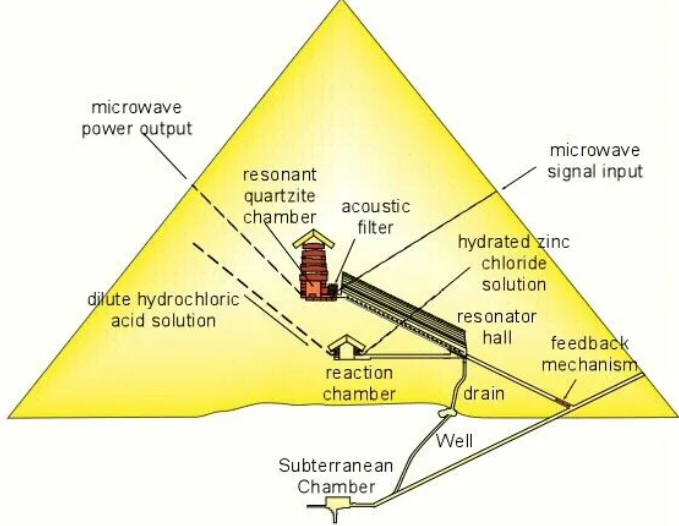
Christopher Dunn, an engineer who spent decades studying the Great Pyramid, argues that it was not just a tomb but a type of machine. In his book The Giza Power Plant, he suggests the pyramid’s shape, chambers and passages were arranged like a giant resonator that worked with Earth’s natural vibrations. He believes these features could amplify and direct energy, much like sound in a musical instrument, leveraging natural power in ways similar to Nikola Tesla’s resonance experiments.
Experiments with radio waves in 2018 showed that the pyramid could focus electromagnetic energy.
Tesla and the Modern Parallel
One of Nikola Tesla’s lesser-known beliefs was that the Great Pyramids of Egypt were not merely monuments, but enormous transmitters of energy. He studied their proportions, locations, and alignment, believing they reflected an understanding of how energy could move through the Earth itself. Tesla imagined a world where energy flowed freely and could be accessed by anyone, raising an intriguing parallel with theories that the pyramids may once have interacted with natural energy in a similar way.
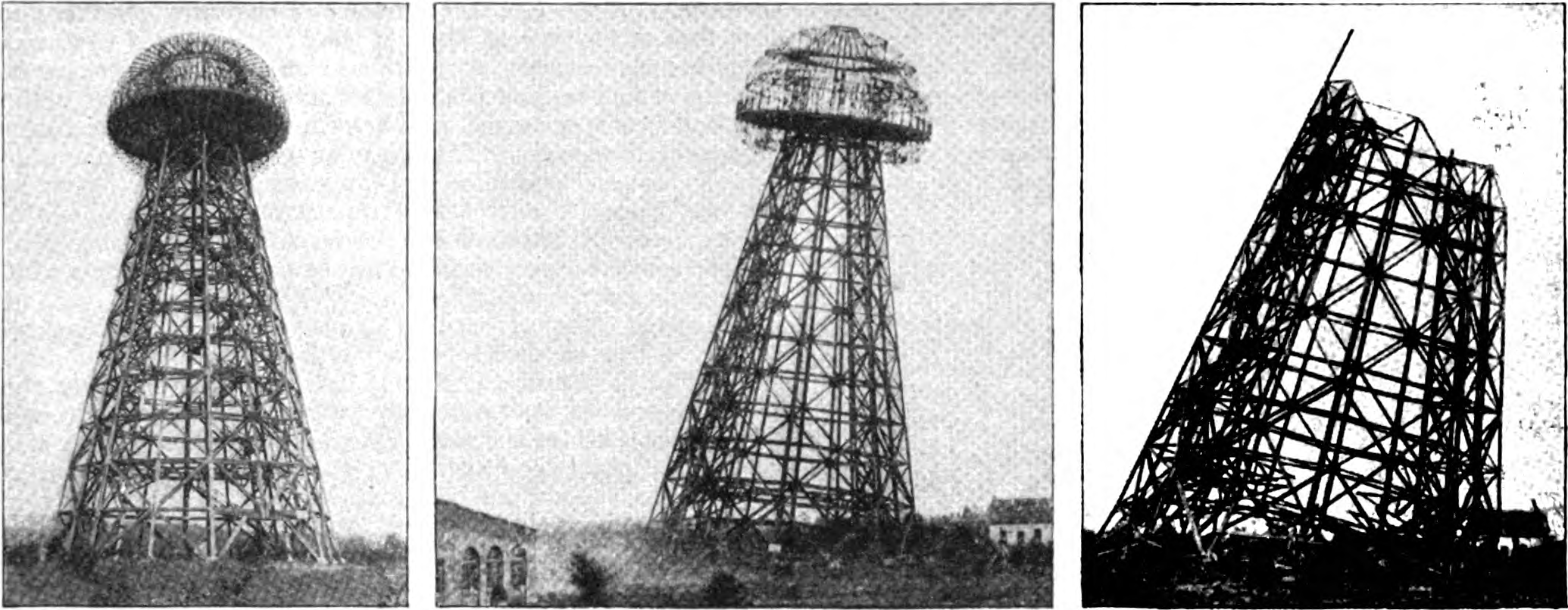
Over a century ago, Tesla pursued a vision that echoed this idea. His Wardenclyffe Tower was designed to transmit energy wirelessly, using resonance with the Earth as a conductor. Despite early breakthroughs, his ideas clashed with powerful industrial interests. Tesla was effectively blacklisted from the energy and electrical industries, funding was cut, and much of his research was suppressed. For a deeper look at Tesla’s work and life, see our full exploration here.
New Discoveries Beneath the Pyramids
For years, ideas about hidden chambers and underground structures beneath the Giza pyramids were dismissed as “conspiracy theories.” But in 2025, new satellite research gave these theories serious credibility. Using advanced radar and vibration analysis, researchers could “see” inside the pyramids without digging.
The team combined Synthetic Aperture Radar (SAR) satellites with a Doppler tomography technique. Instead of trying to penetrate solid stone directly, they measured tiny natural vibrations of the pyramids and surrounding ground caused by seismic activity. These micro-movements revealed hidden cavities and structures underground, effectively making the pyramids and subsoil transparent to observation.
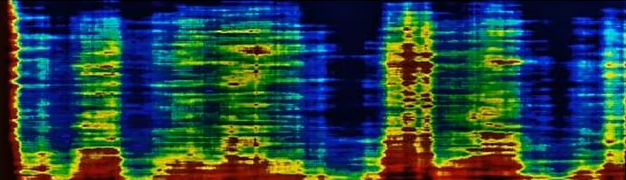
By analyzing repeated satellite passes from different angles, the researchers created detailed 3D maps of the pyramids and the Giza plateau below. Their results suggest a complex network of structures extending nearly 700 meters (2,300 feet) underground.
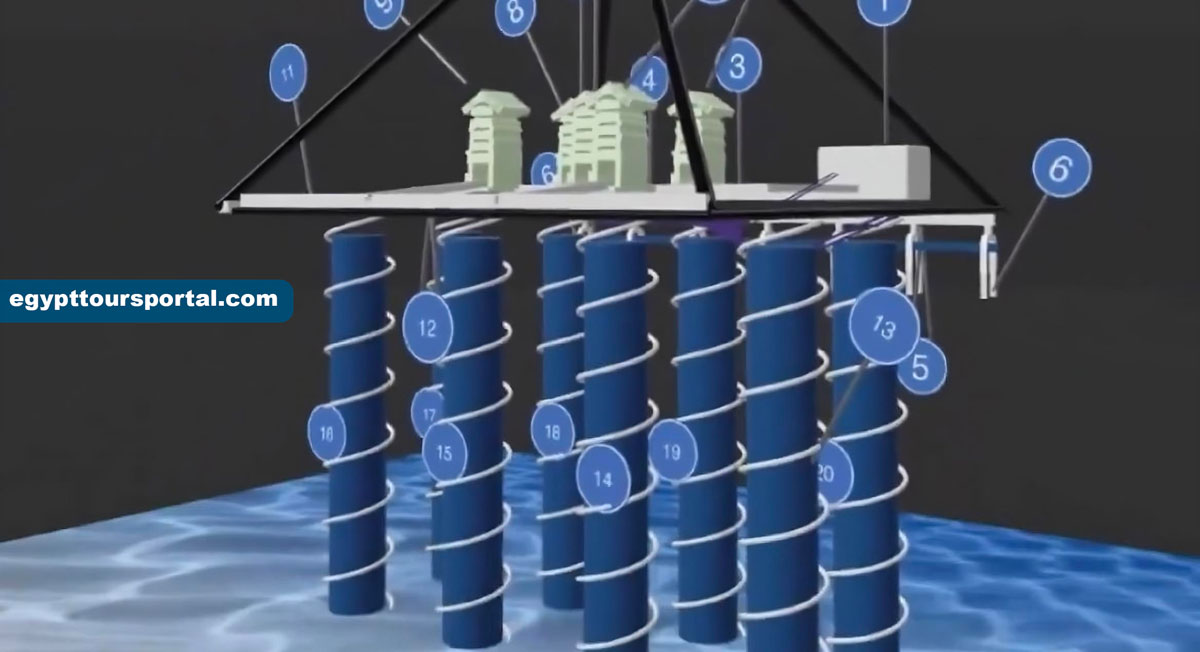
The scans also included “a complex, luminous structure” which the researchers believe is an actual subterranean city. Malanga and Biondi published a separate peer-reviewed paper in October 2022, which found secret rooms and ramps inside Khafre, along with evidence of a thermal anomaly near the pyramid’s base. Taken together, these findings challenge conventional assumptions about the pyramids and the limits of current explanations.
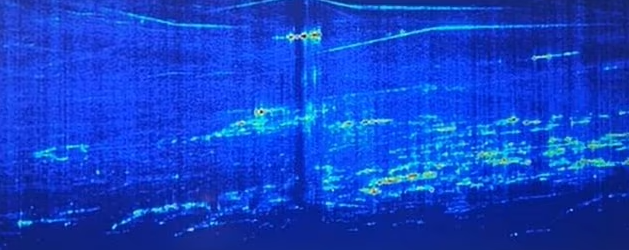
Ideas once ridiculed as “conspiracy theories” are increasingly revisited, suggesting the pyramids may hold far more hidden knowledge than previously thought. The conventional timeline places the Great Pyramid within ancient Egyptian history. Yet its scale, precision, and enduring mysteries hint at another possibility: that some knowledge may have been inherited from earlier, advanced civilizations.
Explore more about history, technology, and power:
- The Rothschild Era
- A Technocratic Future
- Truth as an Instrument of Power
- The PayPal Mafia
- Online Gambling Pandemic
Fit and Free is about staying sovereign in a world that isn’t.