

The phrase “shadow government” sounds like something pulled from late-night forums or conspiracy documentaries. Without the dramatic tone, it simply describes a network of overlapping institutions that make decisions without direct democratic accountability.
This system runs through finance, policy, intelligence, corporate power, and media. Debating whether it exists misses the point. It clearly does. The more relevant question is how organized it is and how far its power reaches.
Early Coordination (Pre–World War II)
Long before modern global institutions existed, smaller circles of coordination were already in place.
The Council on Foreign Relations, founded in 1921, brought together policymakers, financiers, academics, and media figures. As a think tank, it produced research and policy proposals aimed at influencing public opinion and government decisions. While presented as an “independent nonprofit organization,” it functioned as something far more integrated: a setting where ideas were developed alongside those in a position to carry them out.
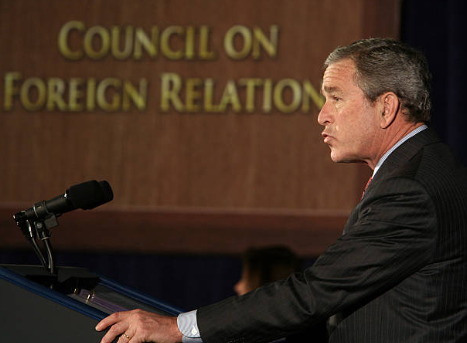
U.S. President George W. Bush speaks to the Council on Foreign Relations, 2005
(Photo: Bloomberg; Photographer: Joe Marquette; via Getty Images)
Initiatives such as the David Rockefeller Studies Program helped move these ideas forward. Rockefeller began funding the Council in the late 1930s and later assumed a leading role within it. His name becomes more relevant as the network expands.
A notable study found that a large share of U.S. government officials were members of the Council. Across administrations, between 40–57% of top foreign policy roles were held by CFR affiliates.
“Members of the Council on Foreign Relations are the nearest thing we have to a ruling establishment in the United States.” — Journalist Richard Harwood.
The Post-War Power Shift
The decisive turning point came after World War II.
The United States came out of the war in a uniquely dominant position. It held a large share of global gold reserves, retained unmatched industrial capacity, and projected power through both military strength and political reach. It effectively set the terms for the emerging global order.
That position was formalized through the Bretton Woods system. The U.S. dollar became central to the international monetary system, while institutions like the International Monetary Fund (IMF), the World Bank, and the Bank for International Settlements (BIS) were created to oversee and maintain it.
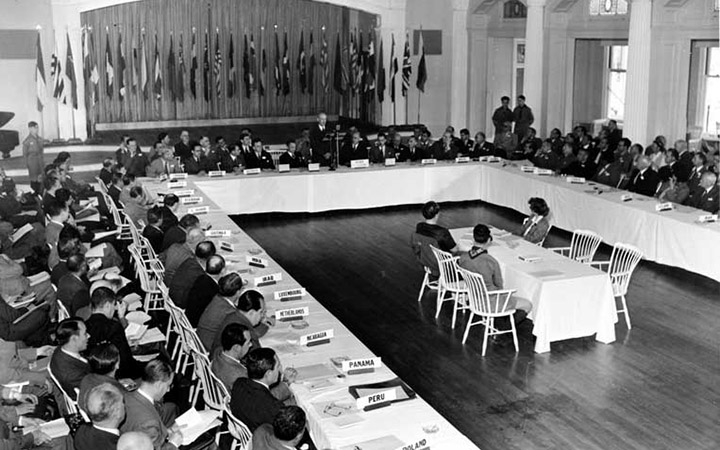
Creation of the Bretton Woods System, New Hampshire, 1944
(Photo: Associated Press; Photographer: Abe Fox)
From this point forward, influence was no longer confined within national borders. Financial systems and policy decisions became closely linked at a global level, largely within a structure defined by American interests.
The Bilderberg Group (1950s)
It is within this post-war order that the Bilderberg Group emerged.
Its first meeting took place in 1954 in the Netherlands, initiated by Prince Bernhard, with the aim of strengthening alignment between Western Europe and the United States during the early Cold War. The guest list reflected that purpose: senior political figures, central bankers, industrial leaders, and members of royalty.
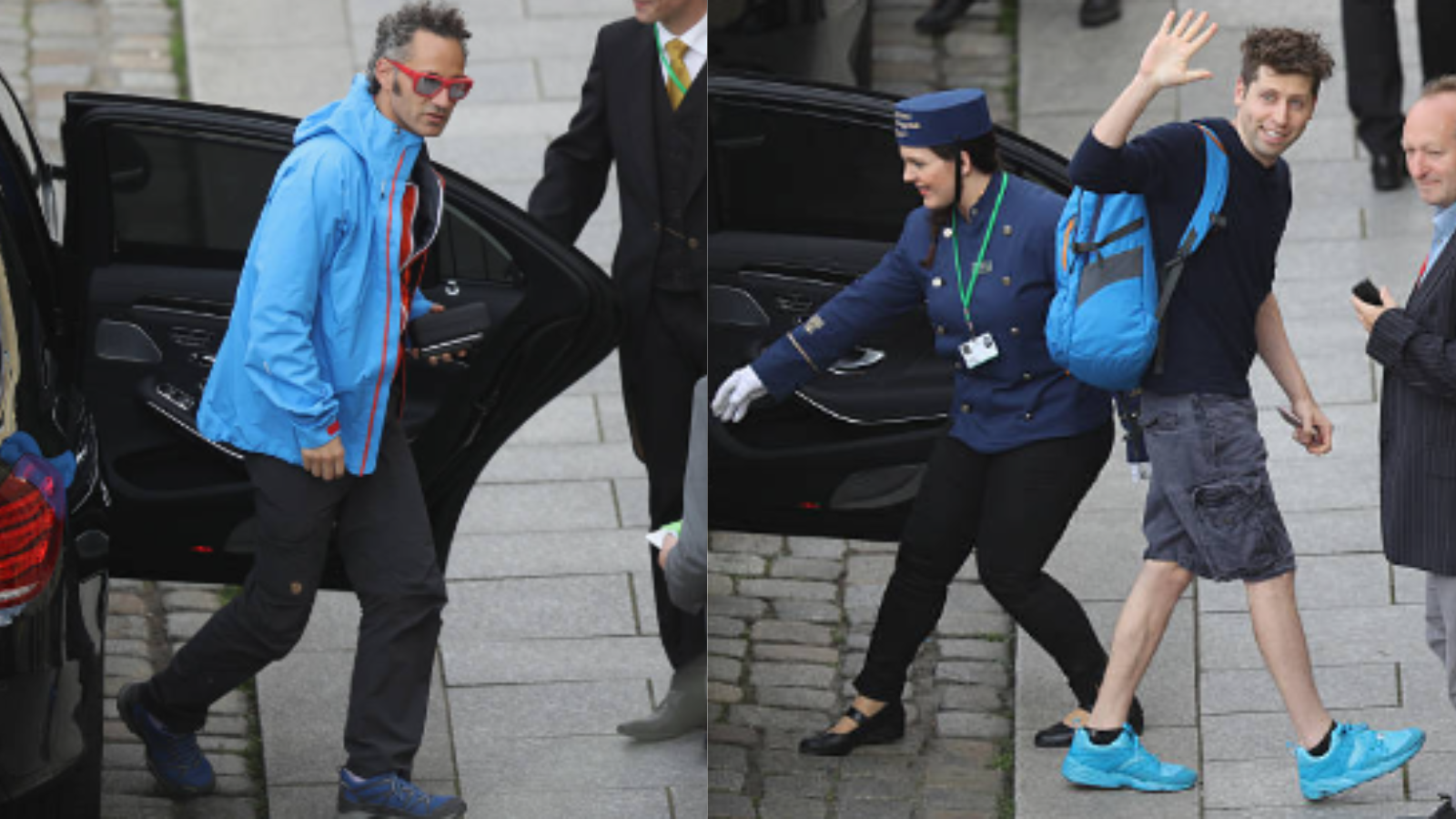
Alex Carp (CEO Palantir) and Sam Altman (CEO OpenAI) at the Bilderberg Group meeting, 2016
(Photo: Getty Images; Photographer: Sean Gallup)
Meetings are held annually behind closed doors. Discussions are off the record, and no transcripts are published. Around 120 to 150 participants attend each year, many of them highly influential in their fields, yet the content of their conversations remains out of public view.
The only cancellation occurred in 1976, following the Lockheed bribery scandal involving Prince Bernhard. Lockheed, a major defense contractor, had paid him to influence aircraft purchases. The company, now known as Lockheed Martin, remains the top contractor to the United States federal government.
“We must guard against the acquisition of unwarranted influence, whether sought or unsought, by the military–industrial complex.” — U.S. President Dwight D. Eisenhower in his Farewell Address, 1961.
Attendance patterns have also drawn attention. Several political figures appeared at Bilderberg meetings before rising to top leadership roles, including Tony Blair, Angela Merkel, Emmanuel Macron, Mark Rutte, and Ursula von der Leyen. In the United States, Bill Clinton attended in 1991 before becoming president, while Barack Obama participated during the 2008 election cycle.
Perhaps it is simply a room full of people who recognize talent early. Or perhaps these meetings function as informal vetting grounds for future leadership. Choose your level of optimism. The same names, families, and long-term interests tend to reappear across institutions. And, speaking of familiar names…
Expansion of the Network (1970s)
By the early 1970s, the system began to expand beyond transatlantic coordination.
In 1973, investment banker David Rockefeller helped establish the Trilateral Commission. Its stated goal was to broaden coordination across North America, Western Europe, and Japan (later expanded to a wider Asia-Pacific presence).
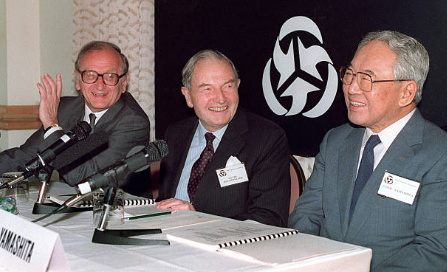
The three chairmen of the Trilateral Commission Georges Berthoin of France (L), David Rockefeller of United States (C) and Isamu Yamashita of Japan (R)
(Photo: AFP; Photographer: Kevin Larkin; via Getty Images)
The membership profile of this “nongovernmental organization” is familiar: leading figures in politics, business, media, and academia. The same categories of people appear across related groups. Overlap between institutions remained common, with individuals moving regularly between public office and private roles. It is one big club, and you are not in it.
The World Health Organization (WHO) was modeled on the Rockefeller Foundation’s International Health Division, adopting its coordinated approach to global health efforts. It has since become a central influence within the United Nations system, guiding international health policy. Notably, the Bill & Melinda Gates Foundation is one of the WHO’s top donors.
In 1975, Congressman Larry McDonald argued that networks like Rockefeller’s were working toward long-term political control through economic channels. He described the effort as “international in scope, generations old in planning, and incredibly evil in intent.”
When Patterns Start to Add Up
As patterns accumulate, they become harder to dismiss. Foreign policy offers a clear example. Since World War II, the United States has led a long series of interventions abroad, including dozens of regime change efforts, prolonged military conflicts such as Vietnam, Iraq, and Afghanistan, and the continued use of economic sanctions.
These operations are often carried out with the support of allied nations, either through formal structures like NATO or looser coalitions of willing states. Economic measures in particular rely on coordinated enforcement across Western economies, which makes them far more effective.
Then 2008 stands out. An unusually high concentration of banking executives had attended Bilderberg meetings shortly before the global financial system nearly collapsed. Governments responded with trillions in taxpayer-funded bailouts, while major financial institutions allocated roughly $20 billion in bonuses, including $29.9 million for JPMorgan Chase CEO Jamie Dimon.
Executives were rewarded, but regular households lost pensions, homes, and long-held savings. The wealth gap widened sharply in the years that followed.
More recently, identity systems, programmable money, artificial intelligence, and data-driven governance have begun to converge into a unified system. This disturbing trajectory is examined in more detail in The Architecture of the Digital Control Grid.
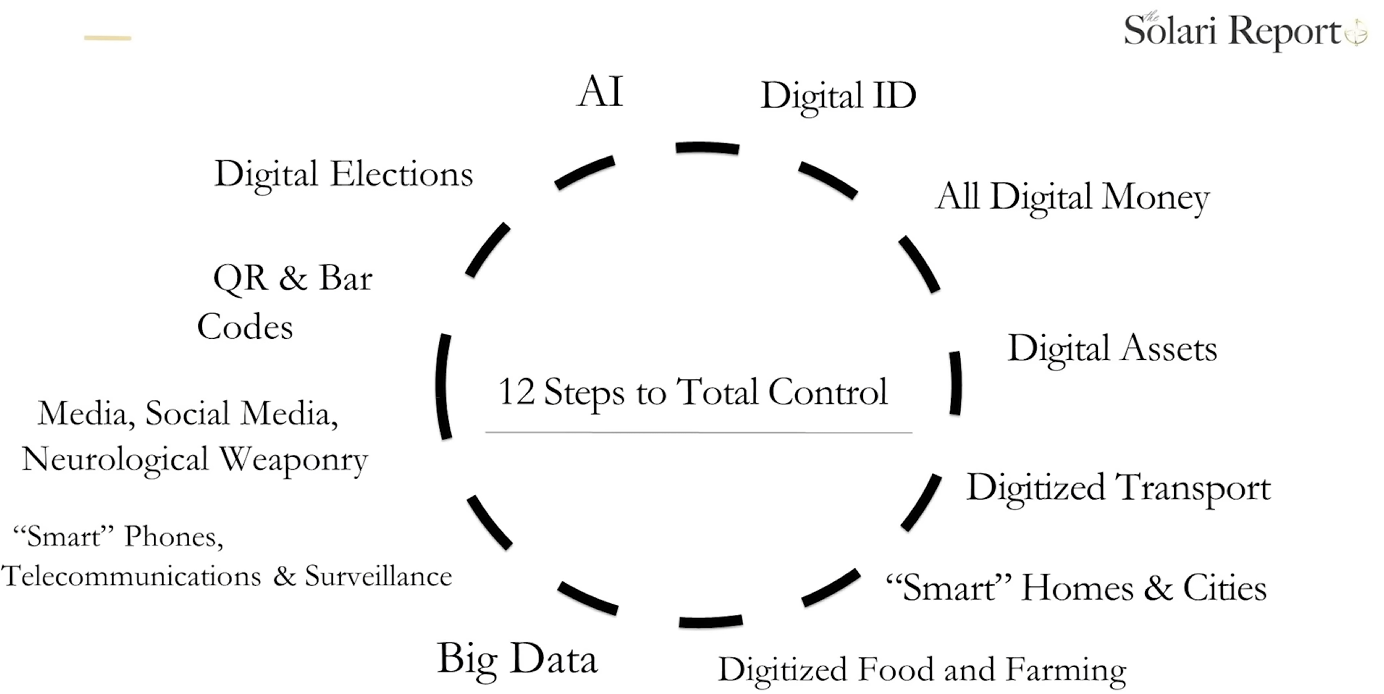
12 Steps to Total Control.
Photo: The Solari Report
Conclusion
So, is there a shadow government? Not in the cinematic sense. What does exist is a dense, interconnected, and largely unelected network that holds strong influence over finance, policy, and media.
Former Canadian Defense Minister Paul Hellyer described a similar structure in his widely discussed 2013 testimony. He extended the idea of a “cabal” to include the groups mentioned earlier, along with international banking interests, intelligence agencies, and elements within the military, operating as a shadow layer across much of the Western world. As Hellyer put it, “the aim of the game is a world government comprising members of a cabal who are elected by no-one and accountable to no-one.”
Henry Kissinger, Zbigniew Brzezinski, George Soros. A full accounting of the individuals moving within these circles would be far too long for this article, and still incomplete. Names and faces change. But is that the whole story? A man my age wonders whether the true centers of power remain hidden.
If these networks are not at the top, then they are part of something even larger. If so, someone else, or something else, sits at the highest level.
We will get there next.
Explore more deep dives connected to power, finance, and the systems behind it: